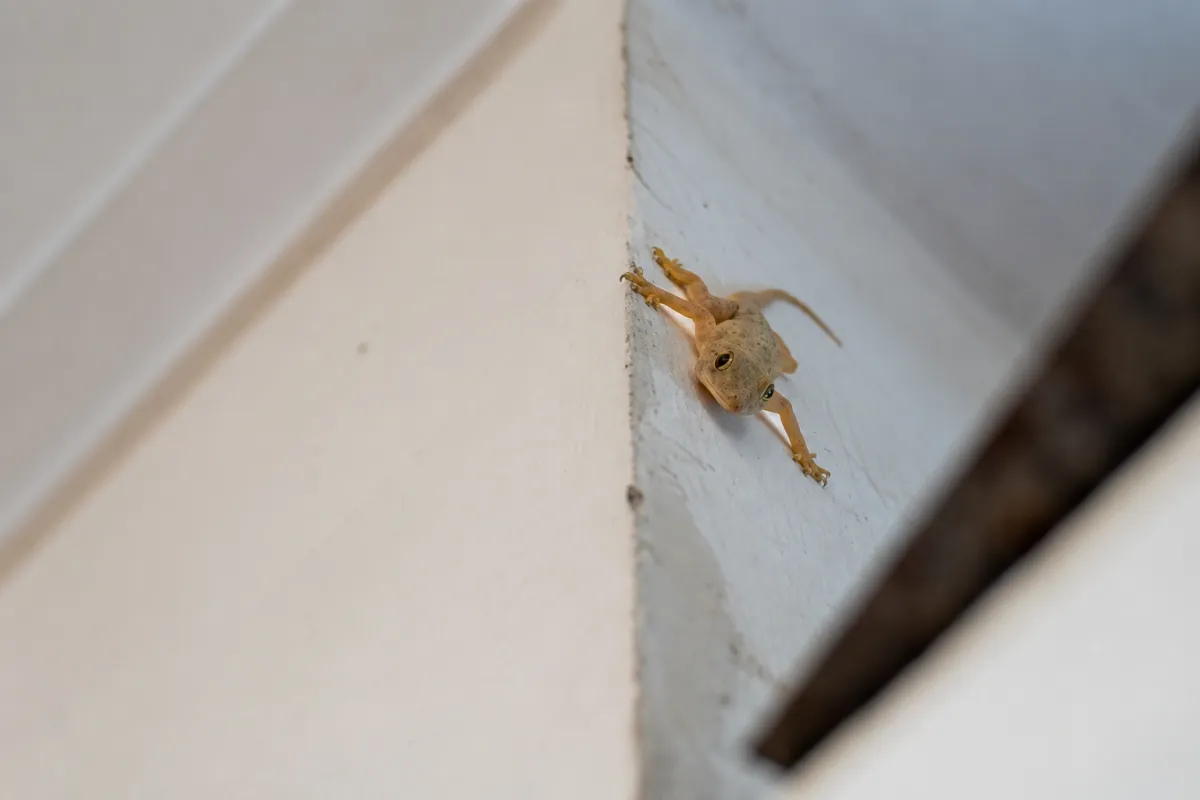

If geckos keep appearing inside your home, the solution may not be to chase them away one by one.
Geckos are attracted to residential properties by conditions that provide what they need: food, water, and shelter. Artificial lighting can attract insects that become food for geckos, while cracks and other sheltered spaces can provide places to hide.
That means one of the most practical ways to reduce geckos indoors is to make your home less attractive and harder to enter.
The good news is that this does not necessarily require pesticides or harsh repellents. A few simple changes to the property can form a more environmentally responsible approach.
If you are unsure whether the gecko is a Tokay or House Gecko, see our guide to gecko safety and identification in Bali before attempting to handle it.
Why Do Geckos Come Into Your Home?
Before trying to keep geckos out, it helps to understand why they are there.
Three environmental factors are particularly useful to consider:
Light, water, and shelter.
These conditions can occur naturally around a property, but buildings can also create them in ways that make the area attractive to geckos.
Light Attracts Insects
Outdoor lighting can attract insects. For a gecko, an area with insects can become a convenient source of food.
This creates a simple relationship:
Light attracts insects → insects provide food → geckos are attracted to the area.
This is particularly relevant around exterior walls, doors, windows, and other areas where lights are positioned close to the building.
Reducing unnecessary lighting can therefore be one part of making the area less attractive to geckos.
Water and Moisture
Water is another environmental factor to consider.
Look around your property for areas where water or moisture is unnecessarily present. If these areas are also close to shelter and insect activity, they may contribute to conditions that attract geckos.
The objective is not to eliminate every source of water around your home.
Instead, identify avoidable water and moisture conditions and manage them where practical.
Shelter and Hiding Places
A building can provide many sheltered spaces.
Cracks, gaps, and other narrow areas can give geckos places to hide. These spaces can also provide opportunities for geckos to remain close to the building without being noticed.
This is why simply removing a gecko may not solve a recurring problem.
If the same property continues to provide attractive conditions and access points, another gecko may appear later.
Seal Cracks and Gaps
One of the most direct ways to reduce gecko entry is to address potential access points.
Inspect areas around:
- Doors
- Windows
- Walls
- Roof areas
- Utility openings
- Pipes and other penetrations
- Visible cracks and gaps
Pay particular attention to openings that connect indoor spaces with the outside.
The objective is straightforward: reduce the number of places where geckos can enter.
Physical exclusion also fits naturally within an Integrated Pest Management approach because it addresses the conditions that allow the problem to continue rather than relying on repeated chemical treatment.
To understand more about why geckos are commonly found around homes in Bali, see our guide to geckos in Bali and how to manage them.
Keep Window Screens in Good Condition
Window screens can help separate indoor living areas from the outdoor environment.
Check screens regularly for:
- Tears
- Loose edges
- Open gaps
- Poorly fitted sections
- Damaged frames
A damaged screen can reduce the effectiveness of the physical barrier around a window.
Keeping screens intact is therefore a simple maintenance step when trying to limit access to indoor areas.
Manage Outdoor Lighting
Lighting deserves particular attention because of its relationship with insect activity.
You do not necessarily need to turn off every outdoor light.
Instead, start by identifying lights that are not needed.
Try These Simple Changes
Switch off unnecessary lights.
If an outdoor light is not needed for security, access, or another practical purpose, consider switching it off when the area is no longer in use.
Avoid unnecessary lighting close to windows and doors.
Lights positioned directly beside an entrance can create insect activity close to one of the easiest access points into a home.
Observe where insects gather.
At night, take a look around the property and identify which lights appear to attract the most insect activity.
This can help you decide where lighting changes may be most useful.
The aim is not to claim that a particular type of bulb is a guaranteed gecko repellent. The more defensible principle is simpler:
less unnecessary insect attraction can mean less food availability around the building.
Reduce Conditions That Support Geckos
Look at the property as a whole rather than focusing on individual geckos.
Ask yourself:
- Where are geckos most often seen?
- Are they concentrated around outdoor lights?
- Are there visible cracks or gaps nearby?
- Are there areas with unnecessary water or moisture?
- Are window screens damaged?
- Are there sheltered spaces immediately around the building?
These observations can help identify why geckos continue to appear.
The goal is to change the conditions that support repeated visits rather than repeatedly removing individual animals.
What About Garlic, Eggshells, and Other Home Remedies?
Search online and you will find many suggestions for keeping geckos away.
Garlic and eggshells are among the commonly discussed remedies.
However, the available evidence for this article does not establish these methods as reliable gecko repellents.
They are better treated as unproven home remedies rather than established pest-management methods.
The same principle applies to homemade sprays and other DIY solutions promoted without strong evidence.
Instead of relying on a substance whose effectiveness is uncertain, start with measures that address the property itself:
seal gaps → manage unnecessary lighting → maintain screens → address avoidable water and shelter conditions.
This approach is more consistent with responsible, non-lethal pest management.
A Simple Eco-Friendly Gecko Prevention Checklist
If you want to reduce geckos inside your home, start with a property inspection.
1. Check Entry Points
Look for cracks, gaps, and openings around doors, windows, walls, and utility penetrations.
2. Inspect Window Screens
Repair damaged screens and make sure they fit properly.
3. Review Outdoor Lighting
Identify lights that are unnecessary and reduce unnecessary lighting, particularly around doors and windows where insect activity may be concentrated.
4. Look for Water and Moisture
Identify avoidable water or moisture conditions around the property.
5. Find Sheltered Areas
Look for cracks, gaps, and narrow spaces where geckos may find shelter.
6. Monitor the Results
Pay attention to where geckos continue to appear.
If sightings remain concentrated in one area, inspect that location again for the combination of light, water, shelter, and access.
This makes prevention an ongoing process rather than a one-time treatment.
Gecko Droppings: Gecko Poop vs. Mouse Poop
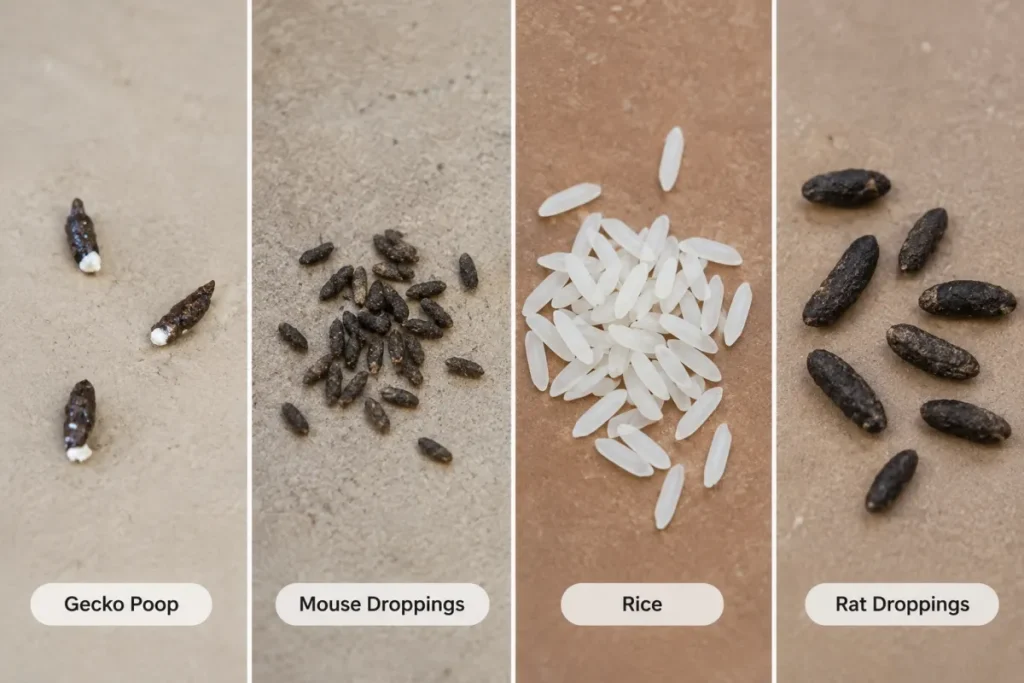
Finding small dark droppings around your home can make it difficult to know which animal left them.
Gecko droppings can have a distinctive white tip, which is associated with uric acid. This can help distinguish reptile droppings from typical mouse droppings.
However, visual identification is not always certain.
Droppings can vary in appearance depending on their condition, location, and other factors. If you are unsure what produced the droppings, avoid relying on appearance alone.
Instead, consider where the droppings are found and whether geckos or rodents are regularly active in that area.
The important point is that both identification and cleanup should be approached carefully.
How to Clean Gecko Droppings Safely
Gecko droppings should be cleaned using normal hygiene precautions because reptiles can carry Salmonella in their faeces. Transmission can occur through the faecal-oral route.
When cleaning droppings:
- Avoid touching them directly with your bare hands.
- Remove the contaminated material carefully.
- Clean the affected surface.
- Wash your hands thoroughly afterwards.
- Take care around surfaces used for food preparation.
The purpose of these precautions is simple: reduce the chance of contaminated material reaching your mouth or food.
Finding gecko droppings does not mean that your home is automatically unsafe. Good cleaning practices and hand hygiene are the practical response.
What If a Gecko Is Already Inside?
Prevention is easier when geckos are outside, but sometimes one will still enter your home.
If you find one indoors, avoid unnecessary handling.
A non-lethal approach is to give the gecko space and guide it toward an exit when practical.
For a large Tokay Gecko, extra caution is appropriate because it can deliver a painful defensive bite if threatened or handled.
The objective is not to fight with the animal.
Give it space, avoid direct handling, and use physical exclusion to reduce the chance of another entry.
Why Eco-Friendly Prevention Works Differently
Traditional pest control is sometimes thought of as finding an animal and eliminating it.
Integrated Pest Management starts with a different question:
What conditions are allowing the problem to continue?
For geckos, that means looking at the environment around the building.
Reducing unnecessary outdoor lighting can address one part of the attraction when it attracts insects.
Sealing cracks and gaps can address another when they provide shelter or access.
Managing avoidable sources of water or moisture can also help change the environment around the property.
This approach does not depend on finding a single “gecko repellent.”
Instead, it combines several small changes that make the property less suitable for repeated gecko activity.
When Should You Consider Professional Help?
Sometimes repeated gecko sightings are a symptom of a broader property issue.
If geckos continue appearing despite reasonable exclusion and environmental management, look beyond the geckos themselves.
A persistent problem may indicate that the building continues to provide easy access, shelter, or abundant insect activity.
In that situation, a property inspection can be more useful than repeatedly treating individual geckos.
The goal should remain the same: identify the conditions contributing to the problem and address them at the source.
Common questions about keeping geckos out
Practical answers about exclusion, lighting, cleaning, and eco-friendly ways to reduce gecko activity around your home.
What is the best natural way to keep geckos out of a house?
Start with physical exclusion and environmental management.
Seal cracks and gaps, maintain window screens, reduce unnecessary outdoor lighting, and address avoidable water and sheltered areas around the property.
Does outdoor lighting attract geckos?
Outdoor lighting can attract insects, and insects provide food for geckos. Managing unnecessary lighting can therefore help reduce conditions that attract geckos around a property.
Should I turn off all my outdoor lights?
Not necessarily.
The practical approach is to identify lights that are not needed and reduce unnecessary lighting, particularly around doors, windows, and other areas where insect activity may be concentrated.
Do garlic or eggshells repel geckos?
These remedies are commonly suggested online, but the evidence available for this article does not establish them as reliable gecko repellents.
They are better considered unproven home remedies.
How can I stop geckos from entering through windows?
Keep window screens intact and check for tears, loose edges, gaps, or other openings.
How can I tell gecko poop from mouse poop?
Gecko droppings may have a distinctive white uric-acid tip, which can help distinguish them from typical mouse droppings. However, visual identification has limitations, so appearance alone should not always be treated as conclusive.
How should I clean gecko droppings?
Avoid touching droppings directly, clean the affected surface carefully, and wash your hands thoroughly afterwards. This helps reduce the risk associated with Salmonella and fecal-oral transmission.
Should I kill geckos that enter my home?
Not necessarily.
A more responsible approach is to reduce the conditions that attract them and limit their access to the building. Non-lethal exclusion can address the immediate problem while environmental management helps reduce repeat visits.
The Bottom Line
Keeping geckos out of your home does not have to begin with a chemical repellent.
Start with the environment.
Reduce unnecessary lighting. Manage avoidable water and moisture. Seal cracks and gaps. Keep window screens in good condition. Look for sheltered spaces around the building.
These measures address the conditions that can make a property attractive to geckos while following a more responsible, non-lethal approach.
If you find gecko droppings, clean them carefully and follow basic hygiene practices.
And if you see a gecko indoors, remember that removing one animal is only part of the solution.
The more useful question is:
What is attracting it here, and what can I change?
Understand the conditions. Prevent the entry. Control wisely.
Sources used for this article
This article was informed by scientific publications, natural history resources, and public health guidance.
Sources are provided for transparency and further reading. They support the factual, ecological, and hygiene-related information discussed in this article.