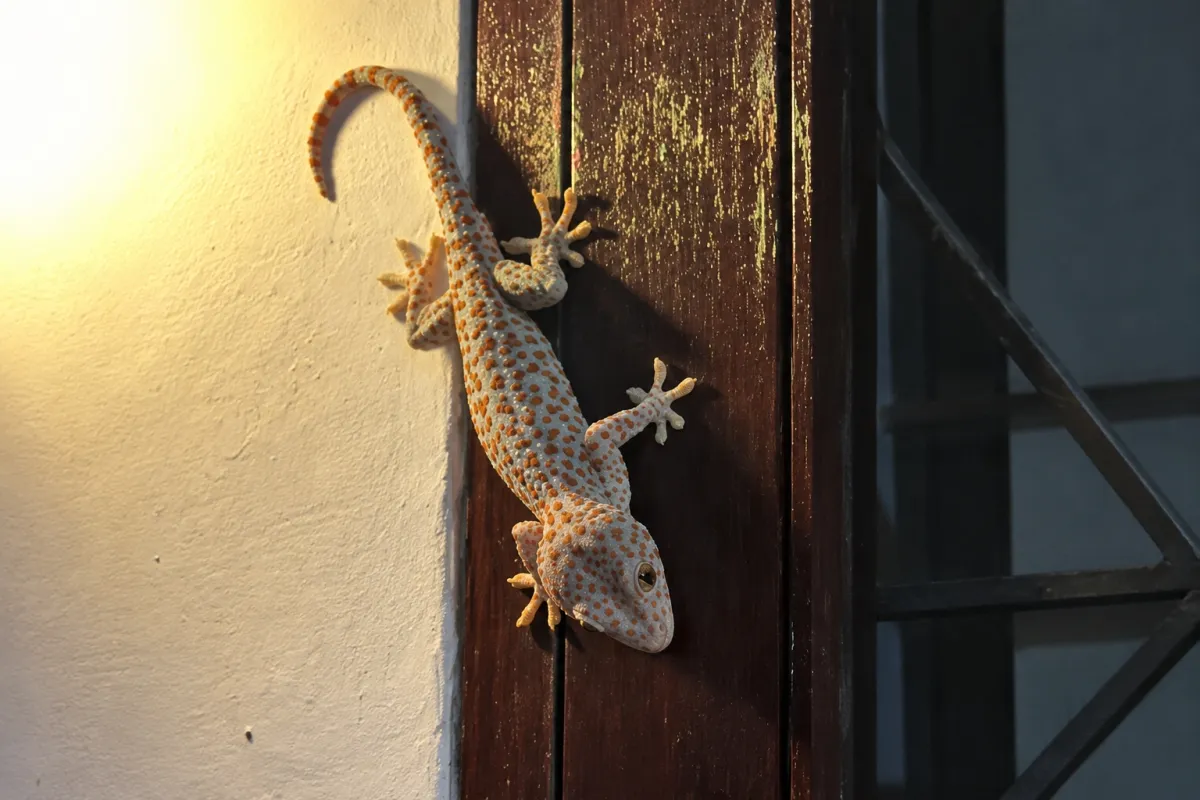

A Tokay Gecko calling from the wall at night can be hard to ignore.
Its loud, unmistakable “to-kay” sound has made the animal familiar across many parts of Southeast Asia. In Bali, however, the sound can carry a meaning that goes beyond biology.
For generations, gecko calls have been associated with signs, omens, good fortune, and other interpretations within local folklore.
But there is an important distinction to make.
A gecko’s call has a biological function. Its spiritual or predictive meaning belongs to folklore and cultural tradition.
Understanding that difference makes the Balinese gecko myth more interesting, not less.
If you are interested in the animal itself, including the differences between Tokay and House Geckos and their potential safety concerns, see our guide to whether geckos in Bali are dangerous.
Why Are Geckos Associated With Good Luck?
In Balinese and Indonesian folklore, the presence or call of a Tokay Gecko can be associated with good fortune, protection, positive energy, or favourable signs.
These interpretations are part of cultural belief rather than established scientific evidence.
The gecko’s presence around the home may therefore be viewed positively. Rather than being seen simply as an animal living on a wall, the Tokay can become part of the symbolic world surrounding a household.
This helps explain why a loud gecko call can sometimes attract attention from people inside a home.
The meaning is not necessarily contained in the sound itself. Instead, the sound becomes a sign that people interpret through a cultural tradition.
This distinction is important when discussing folklore.
There is a difference between saying:
“According to tradition, this call is a good sign.”
and saying:
“The gecko scientifically predicts good fortune.”
The first describes a cultural belief. The second would be a scientific claim that the available evidence does not support.
Folklore vs. Science: What Does a Gecko Sound Actually Tell Us?
From a biological perspective, the sound of a Tokay Gecko has a very different explanation.
The Tokay Gecko (Gekko gecko) uses vocalization as part of its natural behaviour, including communication associated with mating and territorial behaviour.
In other words, the animal is not producing a call because it knows something about a person’s future.
The sound is part of the gecko’s own biological world.
This creates an interesting contrast:
Science asks what the gecko’s call does for the gecko.
Folklore asks what the call means to the person hearing it.
Both questions can exist at the same time, but they should not be confused.
A person may hear a Tokay calling and interpret the sound as a positive sign according to tradition. Biologically, however, the gecko is communicating as part of its own behaviour.
The cultural interpretation belongs to folklore.
The biological explanation belongs to science.
For more background on the geckos commonly found around homes in Bali, see our guide to geckos in Bali and how to manage them.
The Balinese Counting Tradition: What Do Different Calls Mean?
One of the distinctive elements associated with Balinese tradition is a system for interpreting the number of times a Tokay Gecko calls.
According to Primbon Bali, the calls can be counted from 1 through 15, with each total associated with a particular interpretation or omen.
This means that the tradition is more structured than simply deciding whether an odd or even number of calls is good or bad.
The number of calls is treated as meaningful within the traditional system.
Different totals can be associated with different outcomes, such as success, the arrival of guests, or other forms of favourable or unfavourable interpretation.
The important point is how these meanings should be described.
They are traditional interpretations, not scientifically established predictions.
So rather than saying that a particular number of calls will definitely cause an event to happen, it is more accurate to say:
According to the Balinese tradition, that number of calls is interpreted as a particular sign.
This wording respects the cultural tradition without presenting folklore as a law of nature.
Balinese and Javanese Gecko Beliefs: Are They the Same?
This is where online discussions can become confusing.
Some English-language sources describe an odd/even system as a Balinese gecko tradition. The evidence used for this article indicates that this attribution needs to be treated carefully.
The Balinese tradition described in Primbon Bali uses a count-to-15 system, in which different totals have different interpretations.
The Javanese tradition, by contrast, is associated with an odd/even system.
In that system, the person may ask a question internally and then listen to the Tokay’s calls. The calls are interpreted according to an alternating odd/even pattern, which can be used to reach a favourable or unfavourable answer.
This is an important cultural distinction.
Balinese Tradition
Count the calls from 1 to 15.
Each total has its own traditional interpretation.
Javanese Tradition
Interpret the calls through an odd/even system.
The result can be used within the tradition to interpret a question as favourable or unfavourable.
These systems are sometimes mixed together in online articles, but they should not automatically be treated as the same tradition.
When discussing the Balinese gecko myth specifically, the 1–15 counting system is the relevant traditional framework described in the evidence for this article.
Does a Gecko Sound Mean Someone Is Telling the Truth?
Another widespread piece of local folklore connects a gecko’s call with something a person has just said.
According to this belief, if a Tokay Gecko calls immediately after someone makes a statement, the sound may be interpreted as a form of confirmation.
In simple terms, the gecko’s call becomes a sign that the person’s statement is true.
This can be thought of as a kind of truth-confirmation folklore.
For example, someone may make a statement and then notice a Tokay calling from nearby. Within the traditional interpretation, the timing of the call can be treated as meaningful.
But again, this should be understood as folklore.
There is no scientific basis for treating the timing of a gecko’s call as a reliable test of whether a statement is true.
The gecko is responding according to its own biological behaviour. The human interpretation comes from culture.
That distinction allows the tradition to be discussed respectfully without turning it into a scientific claim.
Why Cultural Context Matters
Folklore is rarely as simple as a single rule that everyone follows in exactly the same way.
Beliefs can be passed through families, communities, stories, conversations, and local traditions. As a result, interpretations may differ between households, regions, or generations.
The meaning attached to a particular gecko call should therefore not be presented as something that every Balinese person necessarily believes.
There is no evidence supporting the claim that all modern Balinese people universally use gecko calls as a guide for everyday decisions.
Instead, it is more accurate to describe these ideas as local cultural traditions and folklore.
This distinction is especially important when discussing traditional beliefs with an international audience.
Folklore can be culturally meaningful without being scientifically verifiable.
It can also vary over time.
A tradition may be strongly remembered in one family or community while being less familiar to another.
Why Does the Tokay Gecko Have Such a Strong Cultural Presence?
The Tokay Gecko is particularly memorable because of its distinctive appearance and extremely loud call.
Its presence around homes makes encounters with the animal difficult to ignore.
A quiet animal that rarely makes a sound might easily go unnoticed. A large Tokay calling repeatedly from a wall is different.
The sound creates an opportunity for people to notice the animal, respond to it, and attach meaning to the event.
Over time, repeated encounters can become part of stories and traditional interpretations.
This does not mean that the gecko’s biology created the folklore in any simple or proven way.
It does, however, help explain why a conspicuous animal with a distinctive call can become culturally memorable.
Is the Gecko’s Call Really Predicting the Future?
From a scientific perspective, there is no evidence in the material used for this article that Tokay Gecko calls can predict future events.
The biological explanation is much simpler.
The gecko is vocalizing as part of its natural communication and behaviour.
The prediction comes from the human interpretation of the sound, not from a demonstrated ability of the animal to foresee future events.
This is the key distinction between folklore and science.
A traditional interpretation can tell us something about how people understand the natural world.
It does not automatically tell us that the natural event itself has supernatural predictive power.
How Should We Understand the Balinese Gecko Myth Today?
The most useful approach is neither to dismiss the tradition nor to present it as scientific fact.
Instead, understand both sides.
The biological side tells us that Tokay Gecko vocalizations are connected to the animal’s own communication, including mating and territorial behaviour.
The cultural side tells us that people have developed traditional ways of interpreting those sounds.
The Balinese count-to-15 system is one example of this cultural interpretation.
The Javanese odd/even tradition is another, but it should not automatically be labelled as Balinese.
And the idea that a gecko’s call can confirm the truth of something someone has said belongs to the realm of folklore rather than science.
This distinction allows the cultural history of the gecko to be appreciated without confusing tradition with empirical evidence.
Common questions about Balinese gecko beliefs
Clear answers about traditional gecko beliefs, vocalizations, omens, and the cultural differences between Balinese and Javanese traditions.
Why are geckos considered lucky in Bali?
In Balinese and Indonesian folklore, Tokay Geckos can be associated with good fortune, protection, positive energy, and favourable signs.
These are cultural beliefs rather than scientifically established facts.
What does a Tokay Gecko call mean in science?
Biologically, Tokay Gecko vocalizations are associated with communication, including mating and territorial behaviour.
The call does not scientifically predict future events.
How do Balinese people traditionally interpret Tokay Gecko calls?
The Balinese tradition described in Primbon Bali uses a 1–15 counting system, with different numbers associated with different traditional interpretations.
Is the odd/even gecko system Balinese?
The evidence used for this article distinguishes the systems.
The 1–15 counting system is associated here with the Balinese tradition, while the odd/even system is associated with Javanese tradition.
Does a gecko calling after someone speaks mean they are telling the truth?
This is a form of local folklore in which the timing of the gecko’s call can be interpreted as confirmation.
It should be understood as a traditional belief, not a scientific test of truth.
Does a Tokay Gecko really predict good luck?
There is no scientific evidence that a Tokay Gecko can predict future luck.
The association between the animal and good fortune belongs to folklore and cultural interpretation.
Do all Balinese people believe in gecko omens?
It would be inaccurate to make that generalization.
Cultural beliefs can vary between families, communities, regions, and generations.
Are Balinese gecko beliefs the same as Javanese beliefs?
Not necessarily.
The traditions described in the evidence differ, with the Balinese system using a count-to-15 framework and the Javanese tradition using an odd/even interpretation.
The Bottom Line
The Balinese gecko myth is a good example of how humans can give cultural meaning to an ordinary part of the natural world.
A Tokay Gecko calls because it is communicating as part of its biological behaviour.
People, however, may hear something more in that call: a sign of good fortune, protection, confirmation, or another meaningful event.
The important distinction is simple:
The sound has a biological explanation. Its meaning can have a cultural one.
In the Balinese tradition described here, Tokay Gecko calls may be interpreted through a 1–15 counting system. The Javanese tradition uses a different odd/even framework.
Neither should be confused with scientific evidence that geckos can predict the future.
Understanding that distinction does not make the folklore less interesting.
It shows how deeply animals can become connected to the stories, traditions, and ways people interpret the world around them.
Sources used for this article
This article was informed by cultural references, scientific research, and natural history resources used to distinguish traditional beliefs from biological evidence.
Sources are provided for transparency and further reading. Cultural references describe traditional beliefs and should not be interpreted as scientific evidence.